Plotinus and the Skylight – First Prize at the National Portrait Gallery

My portrait of my neighbor, Jean-Denis, won the first prize at the Herbert Smith Freehills Kramer Portrait Award 2026 at the National Portrait Gallery in London. This has always been considered the most prestigious prize in representational painting, so it was an immense honor to win. To the best of my knowledge, it’s the first time a painting from one of the contemporary painting ateliers has won so it was an exciting moment for our whole movement.

I’ve embedded a video below where I discuss the Platonic and Plotinian ideas that went into the portrait, and I’ve written them out below as well, for people who prefer text.

The story behind the portrait is as follows. I had recently put in a new floor in my painting studio which allowed me to paint portraits again. At the same time, the studio has a skylight, which is a higher light source than I have had before, and I wanted to get used to it before I took any commissions. I tried a self-portrait, and a portrait of my wife, but then I thought I should ask some neighbors if they wanted to pose. Before I had the chance, in a curious synchronicity, my neighbor across the street said he was interested in having his portrait painted. We made a deal where he could keep the portrait but first I could enter it into a contest. After painting him once, I decided that I didn’t want to come and take his painting away for a contest so I painted him a second time.

For the second portrait, I thought I would try to combine him as he is with the Platonic ideal of a person, which used to be a pretty common method of portrait painting.

For those who don’t remember, Plato’s Theory of Forms states that there is an ideal version of things that exists outside of time and space. In book 10 of the Republic, he uses the example of a bed. God has made an ideal bed that does not exist physically, and whenever a carpenter makes a bed, no matter how beautiful, they are making an inferior copy of the ideal bed. At this point in the Republic, Plato goes after painters who paint a painting of a bed as making an inferior copy of an inferior copy – “the imitator, I said, is a long way off reality…”. It’s quite ironic as this passage has had such a profound influence on artists over the millennia. Rather than be discouraged by their inability to capture truth, artists decided they could just imagine the ideal bed in their heads and paint from that.

This is a theory that was discussed often when I studied portrait painting in Florence as much of Florentine art was based on the practice of either working from the imagined ideal, or combining reality with the ideal. One interesting sidenote is that as I was rereading Alberti, Bellori, and Reynolds, I forgot that none of them really credits Plato with the notion. They talk about Cicero or Proclus, even though it is mostly based on Plato’s Theory of Forms. I also recently discovered that Erwin Panofsky, one of my favorite art historians, has a great book called ‘Idea’ which goes through the development of this theory, with the sources, and saves one from buying all the original texts. Unfortunately he stops with the Italian Baroque, as I’ve been trying to find the history of the theory in French art and, of course, it was so important in British portrait painting.

On that note, I’d like to place here the quote from the 4th Discourse of Sir Joshua Reynolds that I read in the video as it really sums it up well with regards to portraiture. He is discussing the ‘great style’ which he has contrasted with copying things as they appear:

It may be asserted, that the great style is always more or less contaminated by any meaner mixture. But it happens in a few instances, that the lower may be improved by borrowing from the grand. Thus if a portrait-painter is desirous to raise and improve his subject, he has no other means than by approaching it to a general idea. He leaves out all the minute breaks and peculiarities in the face, and changes the dress from a temporary fashion to one more permanent, which has annexed to it no ideas of meanness from its being familiar to us. But if an exact resemblance of an individual be considered as the sole object to be aimed at, the portrait-painter will be apt to lose more than he gains by the acquired dignity taken from general nature. It is very difficult to ennoble the character of a countenance but at the expense of the likeness, which is what is most generally required by such as sit to the painter.

At the award ceremony, I was told that the judges appreciated the ‘timeless presence’ of Jean-Denis, so this attempt at painting the Platonic ideal, via Reynolds, bore fruit.

In the video I also discuss an idea of the third-century Neoplatonic philosopher Plotinus which helped with my skylight problem. One issue I have with the high light source is that the eye-sockets are in shadow and conceal the eyes. As portrait painters, we are always told that we have to ‘capture the soul of our sitter’ and that the ‘eyes are the windows to the soul’, implying that the soul is hidden in the body. Plotinus, however, said that the soul is not in the body, but rather the body rests in the soul, ‘like a net in the sea’. With this conception, in which the soul surrounds and permeates the body, the eyes don’t have to do so much heavy lifting in a portrait.

For the record, I have never seen anyone’s soul, but I find it a beautiful way to try to envisage the world.

The Estremoz Paintings

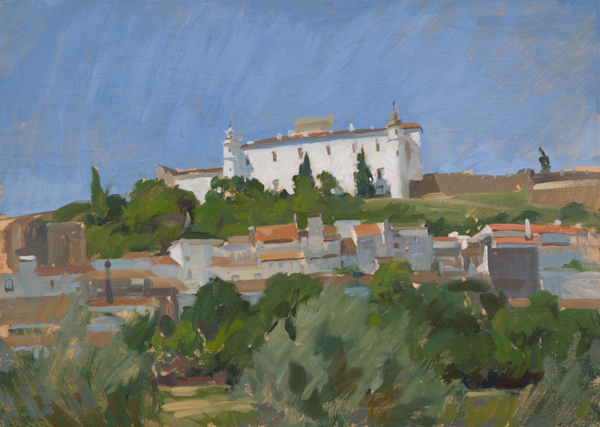
Estremoz Castle, Spring
Estremoz Castle, Spring. 25 x 35 cm, oil on panel.
Estremoz Castle in the Summer
Estremoz Castle, Summer. 25 x 35 cm, oil on panel.
Oil painting of Estremoz Castle in the Autumn
Estremoz Castle, Autumn. 20 x 30 cm, oil on panel.
Estremoz Castle, winter
Estremoz Castle, Winter. 20 x 30 cm, oil on panel.

It’s been over a year now since we left Portugal, and even longer since I last wrote a blog post, but I wanted to show the series of paintings I did while we were living in the beautiful town of Estremoz. I had hoped to exhibit them as a group at the time, but between the Covid lockdowns and our other shows, I never got a chance to organize it.

Estremoz Castle #5. 20 x 30 cm, oil on panel.

(Above is a YouTube video of the process for the previous painting).
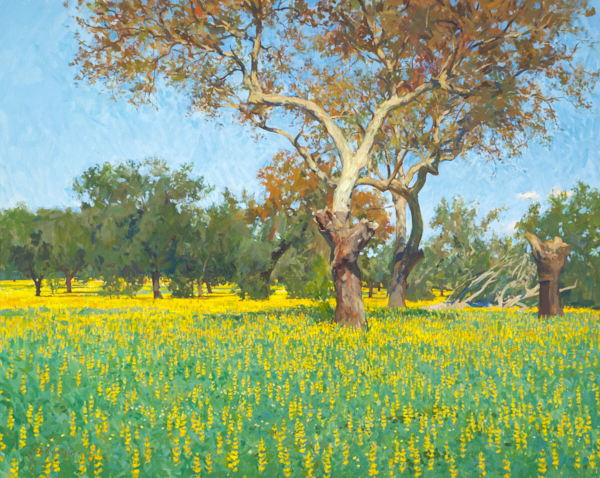
oil painting of a field of
Yellow Lupine in an Cork Forest. 70 x 90 cm, oil on linen.

We loved our three years living in Estremoz. The Portuguese people were as wonderful as everyone says, the towns, cities and landscapes of the Alentejo are gorgeous, and the history and culture is utterly fascinating. I had no idea how much of the world’s culinary culture was influenced by the Portuguese. From the vindaloo curries of Goa, to Japanese tempura, to the multitude of peppers worldwide, Portugal had a huge influence on food everywhere they went.

Today as well, the food in the Alentejo and the Algarve is amazing, and not as well known as it should be. The seafood is especially great, in part because the area south of the Tagus (Tejo) river is the only area in Europe where cilantro is still part of the regional cuisine.

Today there are a lot of great restaurants in Estremoz, but we especially loved Larau and Mercearia Gadanha.

Saturday Market, Estremoz. 20 x 30 cm, oil on panel.
Oil painting of Carnival in Estremoz
Carnival Parade, Estremoz. 20 x 30 cm, oil on panel.
Cafe Alentejano
Café Alentejano, Sunday Morning. 20 x 30 cm, oil on panel.
trees in bloom painting
Spring, Estremoz. 20 x 30 cm, oil on panel.
Câmara Municipal, Estremoz
Tower of the City Hall, Estremoz. 30 x 20 cm, oil on panel.
Artists Society of Estremoz
The Artists Society of Estremoz. 25 x 28 cm, oil on panel.

We hadn’t originally planned on living in Portugal. It was one place on our list of possible places after my wife finished her studies at the Florence Academy of Art. But we really liked our time scouting in the Alentejo so we thought we would just look around at possible towns. One problem we had at first is that much of the architecture is designed around small windows as the summers are so hot. As artists we were looking for large windows with a lot of natural light. So we were thrilled when we discovered Estremoz. Much of the town is built on the north facing side of the hill under their castle, and there are a number of old, beautiful buildings with large north-facing windows.

Sociedade de Artistas Estremocense
Largo General Graca, Estremoz. 25 x 35 cm, oil on panel.

As we walked around on our first visit, we stumbled across a large, ornate, empty building with large north-facing windows. The plaque next to the door read ‘Sociedade de Artistas Estremocense’, the Artists Society of Estremoz, so we asked next door if anything was for rent, and moved in a few months later.

We are very thankful to the Sociedade de Artistas for all their help in getting us settled into their beautiful building, and into the life and culture of Estremoz.

Rossio Marquês de Pombal painting
Rossio Marquês de Pombal. 20 x 30 cm, oil on panel.
wildflower painting
Wildflowers. 25 x 35 cm, oil on panel.
R. da Campainha painting in Estremoz.
Rua da Campainha, Estremoz. 30 x 20 cm, oil on panel.
(Another process video, with thoughts on urban plein air painting in general).

plein air painting of the Igreja de São Francisco
Igreja de São Francisco. 20 x 30 cm, oil on panel.

I also painted a few larger paintings. One is posted above, and here are a couple more:

large plein air landscape painting of Estremoz castle.
Estremoz Castle. 120 x 140 cm, oil on linen.
Plein air painting of my wife on our terrace in Estremoz.
Tina on the Terrace, Estremoz. 120 x 90 cm, oil on linen.

This last one is of my wife on our terrace in the Artists Society building. I love the huge chimneys that you see all around the Alentejo, apparently they were for curing meat for storage.

sunset painting
Sunset, Estremoz. 20 x 30 cm, oil on panel.

Overall we had a wonderful time in the Alentejo and it is a period of our life that, despite the Covid pandemic, we will always look back on fondly.

Portrait Painting Video

I’ve recently posted a demo video of laying-in a portrait in oils using the sight-size method. I hope you enjoy it.

These days my videos go first to my Patreon supporters for three months. After three months I release them to the public on my YouTube channel.

If you get something out of these videos, please consider supported my equipment budget through Patreon. I make all these videos myself.