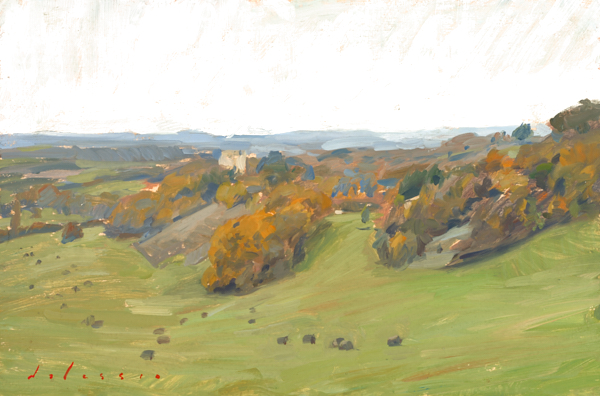
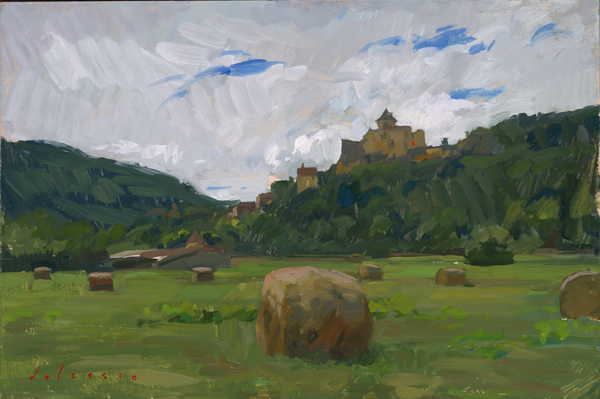
Here are some recent larger landscapes from 2025 and 2026. The first three are plein air paintings and the rest were done in the studio from studies. I haven’t been posting much lately on the blog as I usually post all of my work to social media.
Église Saint-Pierre de Genens. 80 x 100 cmSun Dog, Lavardens. 90 x 110 cm.Evening Light, Gigondas. 90 x 110 cm.
Plum Trees in Bloom, La Romieu. 25 x 35 cm, oil on panel.
We’ve been living in the Gers region of France now for over a year and I thought I should post some of the work I’ve done. As I’ve written in the past (here and here), the landscapes here are wonderful for plein air painting, and the sort of subjects that I’ve looked for for years.
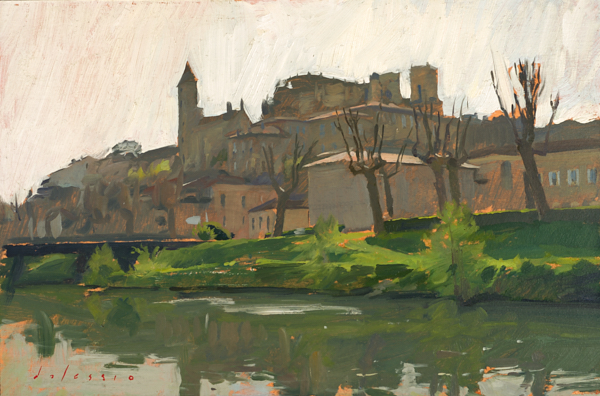
Wheat Fields below Lectoure. 90 x 120 cm, oil on linen.Castle Ruin, Autumn. 20 x 30 cm, oil on panel.Chapelle Saint-Michel in Winter. 20 x 30 cm, oil on linen.
It’s a very open landscape. Apparently there used to be many more vineyards but they were pulled out in the 20th-century to make more fields for sunflowers and wheat. I’ve always much preferred the later two as subject matter, but if we need vineyards there are still some nearby, and there a lot further north and west where there are more grapes grown for the Armagnac.
Fall Vineyard, Jegun. 20 x 30 cm, oil on panel.
The Gers is also wonderfully free of olive trees, as I developed a terrible allergy to olive pollen in Tuscany which ruined the painting season for me from late April to June. The last couple of years in Florence I was reduced to painting still lifes in the Spring as it got so bad (no offense to still life painters). I also developed an allergy to cypress trees, and thankfully there are far less of them here as well.
With all that said, because of the drier summers we’re having in Southwestern France due to climate change, there is talk of farmers starting to plant more olive trees and I’ve seen a couple of new fields of them.
Cypresses at Chapelle Sainte-Marie. 80 x 100 cm, oil on linen.The View from Lavardens. 90 x 120 cm, oil on linen.
Camille Corot’s painting from 1826 of the Augustinian Bridge at Narni in southern Umbria had a profound effect on me when I was starting out as a landscape painter and I especially loved the subtle blue reflection of the sky in the mustard colored water of the Nera river. For this reason I was very happy to discover that the three major rivers that run down from the Pyrenees and head north past us to the Garonne all regularly have the same ocher water from the clay in the soil.
The Baïse at Pléhaut. 30 x 20 cm, oil on panel.
The Osse at Vic-Fezensac. 35 x 25 cm, oil on panel.
Early Spring, Auch. 20 x 30 cm, oil on panel.
We settled in the village of Jegun. It’s a charming, vibrant village with lovely inhabitants. It’s also pretty but not too pretty. After 20 years in the center of Florence I was interested in living somewhere where tourism took a back seat to the lives of the locals.
Rue Sainte-Marie, Jegun. 30 x 20 cm, oil on panel.
Grande Rue, Jegun. 20 x 30 cm, oil on panel.The Irish Pub, Jegun. 20 x 30 cm, oil on panel.Sunflower Fields below Jegun. 80 x 92 cm, oil on linen.
Nearby we have a wealth of picturesque subject matter, including the very beautiful departmental capital of Auch which is only 20 minutes away, as well as agricultural scenes and the rolling hills of Gascony.
Lavardens. 20 x 30 cm, oil on panel.Sainte-Marie Cathedral, Auch. 20 x 30 cm, oil on panel.Combine Harvester. 20 x 30 cm, oil on panel.Autumn Crocuses, Bonas. 20 x 30 cm, oil on panel.Evening Light near La Sauvetat. 20 x 30 cm, oil on panel.
It’s been a wonderful first year and we look forward for many more to come.
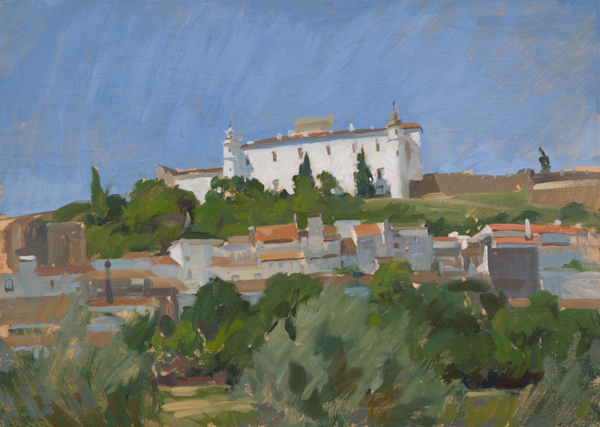
Estremoz Castle, Spring. 25 x 35 cm, oil on panel.
Estremoz Castle, Summer. 25 x 35 cm, oil on panel.
Estremoz Castle, Autumn. 20 x 30 cm, oil on panel.
Estremoz Castle, Winter. 20 x 30 cm, oil on panel.
It’s been over a year now since we left Portugal, and even longer since I last wrote a blog post, but I wanted to show the series of paintings I did while we were living in the beautiful town of Estremoz. I had hoped to exhibit them as a group at the time, but between the Covid lockdowns and our other shows, I never got a chance to organize it.
Estremoz Castle #5. 20 x 30 cm, oil on panel.
(Above is a YouTube video of the process for the previous painting).
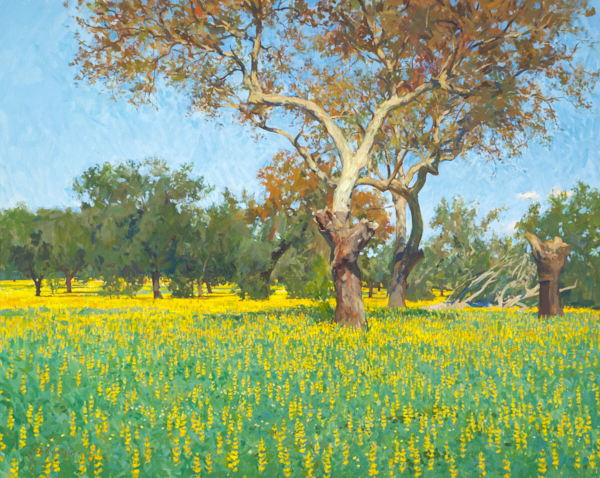
Yellow Lupine in an Cork Forest. 70 x 90 cm, oil on linen.
We loved our three years living in Estremoz. The Portuguese people were as wonderful as everyone says, the towns, cities and landscapes of the Alentejo are gorgeous, and the history and culture is utterly fascinating. I had no idea how much of the world’s culinary culture was influenced by the Portuguese. From the vindaloo curries of Goa, to Japanese tempura, to the multitude of peppers worldwide, Portugal had a huge influence on food everywhere they went.
Today as well, the food in the Alentejo and the Algarve is amazing, and not as well known as it should be. The seafood is especially great, in part because the area south of the Tagus (Tejo) river is the only area in Europe where cilantro is still part of the regional cuisine.
Today there are a lot of great restaurants in Estremoz, but we especially loved Larau and Mercearia Gadanha.
Saturday Market, Estremoz. 20 x 30 cm, oil on panel.
Carnival Parade, Estremoz. 20 x 30 cm, oil on panel.
Café Alentejano, Sunday Morning. 20 x 30 cm, oil on panel.
Spring, Estremoz. 20 x 30 cm, oil on panel.
Tower of the City Hall, Estremoz. 30 x 20 cm, oil on panel.
The Artists Society of Estremoz. 25 x 28 cm, oil on panel.
We hadn’t originally planned on living in Portugal. It was one place on our list of possible places after my wife finished her studies at the Florence Academy of Art. But we really liked our time scouting in the Alentejo so we thought we would just look around at possible towns. One problem we had at first is that much of the architecture is designed around small windows as the summers are so hot. As artists we were looking for large windows with a lot of natural light. So we were thrilled when we discovered Estremoz. Much of the town is built on the north facing side of the hill under their castle, and there are a number of old, beautiful buildings with large north-facing windows.
Largo General Graca, Estremoz. 25 x 35 cm, oil on panel.
As we walked around on our first visit, we stumbled across a large, ornate, empty building with large north-facing windows. The plaque next to the door read ‘Sociedade de Artistas Estremocense’, the Artists Society of Estremoz, so we asked next door if anything was for rent, and moved in a few months later.
We are very thankful to the Sociedade de Artistas for all their help in getting us settled into their beautiful building, and into the life and culture of Estremoz.
Rossio Marquês de Pombal. 20 x 30 cm, oil on panel.
Wildflowers. 25 x 35 cm, oil on panel.
Rua da Campainha, Estremoz. 30 x 20 cm, oil on panel.
(Another process video, with thoughts on urban plein air painting in general).
Igreja de São Francisco. 20 x 30 cm, oil on panel.
I also painted a few larger paintings. One is posted above, and here are a couple more:
Estremoz Castle. 120 x 140 cm, oil on linen.
Tina on the Terrace, Estremoz. 120 x 90 cm, oil on linen.
This last one is of my wife on our terrace in the Artists Society building. I love the huge chimneys that you see all around the Alentejo, apparently they were for curing meat for storage.
Sunset, Estremoz. 20 x 30 cm, oil on panel.
Overall we had a wonderful time in the Alentejo and it is a period of our life that, despite the Covid pandemic, we will always look back on fondly.
View from the Fortress at Arrifana. 20 x 30 cm, oil on panel.
We were back in the Algarve painting landscapes this October. Here are a few of the images. As before, we were based in the small town of Praia da Luz, outside of Lagos. And, as before, we had great weather and were constantly inspired by the beauty of the area.
Cliffs at Ponta da Piedade. 35 x 25 cm, oil on panel.
Rock Formations, Dona Ana. 20 x 30 cm, oil on panel.
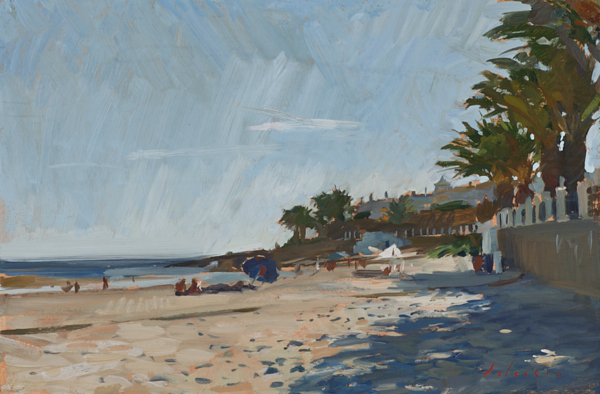
Praia da Dona Ana. 20 x 30 cm, oil on panel.
Ponta da Piedade Back-lit. Oil on panel, 30 x 20 cm.
Afternoon Light, Ponta da Piedade. 20 x 30 cm, oil on panel.
Afternoon Light, Don Camilo. 24 x 18 cm, oil on panel.
We painted the rock formations around Lagos a lot as it’s a subject that I find both new and inspiring. Much of the coast in the Algarve faces south, so one has a choice of the various light effects all day long. It’s also easier for working en plein air as there is usually less wind than on the western coast.
That said, we did head over to the western beaches a couple of times:
Cliffs, Dos Mouranitos. 30 x 20 cm, oil on panel.
Praia do Castelejo. 20 x 25 cm, oil on panel.
And we painted a lot around Praia da Luz, where we were staying. I’ve always loved painting palm trees.
Praia da Luz. 20 x 30 cm, oil on panel.
Praia da Luz #2. 20 x 30 cm, oil on panel.
Afternoon Light, Praia da Luz. 25 x 35 cm, oil on panel.
Sunset, Praia da Luz. 18 x 25 cm, oil on panel.
At the end of our trip we drove up to Porto Covo, on the Alentejano coast. It’s also a very beautiful area, less dramatic than further south, but with the authenticity we like so much in this region.
Porto Covo. 20 x 30 cm, oil on panel.
Fishing Huts, Porto Covo. 20 x 30 cm, oil on panel.
View from the Fort at Pessegueiro. 20 x 30 cm, oil on panel.
Fishing Boats, Porto Covo. 20 x 30 cm, oil on panel.
Overall it was a great trip. September and October can be two of the harder months for landscape painting in Europe as the colors go very brown in the countryside. The fields are tilled and left, and the rains start again. The coast of Portugal is a great area for painting in this time of year as it’s still often very warm and dry, and the light is as beautiful as always. I highly recommend it.
My wife and I will be having an exhibition in Château de la Treyne on the Dordogne river, in the Lot region of France this coming July.
All of the small paintings were painted on site last summer, when we had an opening in the lockdowns here in Europe. The larger paintings were painted in the studio this winter, either finished from plein air starts, or enlarged from sketches done in the field.
Bend in the Dordogne. 100 x 140 cm, oil on linen.
It’s a stunningly beautiful area, and this is the second summer we have spent painting there. We are normally based near Domme, as we work with the V&A Gallery in Sarlat-la-Canéda, but for this trip we worked much more to the east, to try to paint areas closer to the Chateau.
The castle itself is a spectacular property and we received a very warm welcome from the wonderful owners.
Afternoon Light, Château de la Treyne. 80 x 100 cm, oil on linen.
One thing I really love about the Dordogne is how clean the water is. The areas where we were painting were full of water crowfoot, with bees pollinating the flowers that sit just out of the water. And it’s great to see such a large river so teeming with fish and frogs.
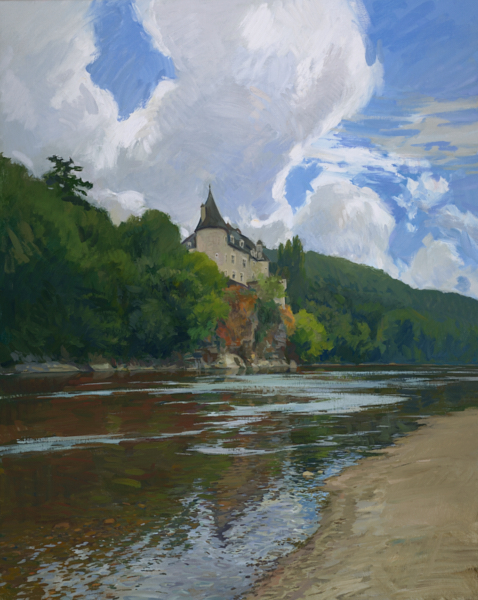
Passing Cloud, Château de la Treyne. 100 x 80 cm, oil on linen.
Walnut Grove. 90 x 120 cm, oil on linen.
Above are all the larger pieces fresh from the studio. Below are all of the smaller, plein air work from the summer. The first group are the ones I used as reference for the studio paintings.
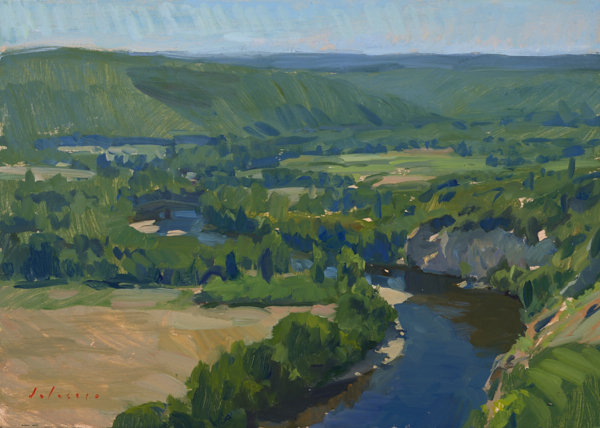
The Dordogne from above Pinsac. 25 x 35 cm, oil on panel.Afternoon Light, Château de la Treyne. 20 x 30 cm, oil on panel.
Passing Cloud. 30 x 20 cm, oil on panel.
Walnut Grove. 20 x 30 cm, oil on panel.
Banana Tree, Martel. 30 x 20 cm, oil on panel.
Canoe Rental, Pinsac. 20 x 30 cm, oil on panel.Reilhaguet. 25 x 35 cm, oil on panel.Château de Belcastel. 20 x 30 cm, oil on panel.
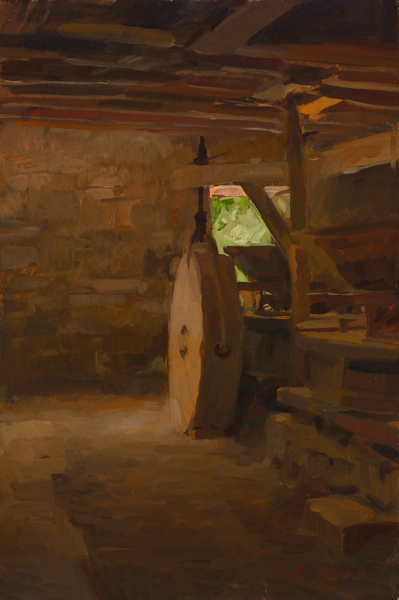
Milling Stone, Moulin de Cougnaguet. 30 x 20 cm, oil on panel
Reflections, Pinsac. 20 x 30 cm, oil on panel.Castelnaud-la-Chapelle Castle. 20 x 30 cm, oil on panel.
Gardens at Château de la Treyne #1. 30 x 20 cm, oil on panel.
Gardens at Château de la Treyne #2. 30 x 20 cm, oil on panel.
Gardens at Château de la Treyne #3. 25 x 35 cm, oil on panel.Cutting Garden. 25 x 35 cm, oil on panel.